
27
2026
-
08
Anti-Slip Webbing Explained: Latex Yarn, Drip-Coating and Woven-in Structures
Author:
Introduction
Webbing looks simple, yet it hides real engineering. As outdoor, pet, medical and industrial applications demand more from textile accessories, anti-slip webbing has become one of the most talked-about technologies in the industry. By adding surface texture or special treatment to regular webbing, anti-slip webbing significantly increases friction so that components stay firmly in place. Here is a practical guide to the main processes and selection criteria.
1. Three Main Anti-Slip Processes
One-piece latex yarn weaving: latex yarns are woven directly into the strap, creating a raised texture in a single production step with no secondary processing. It is highly efficient and the most common solution today.
Drip-coating surface treatment: silicone, PVC or TPE coatings are applied onto nylon, polyester or elastic bases and cured into micro-dot patterns or a continuous layer. This requires a second processing step; initial grip is excellent, but the coating may peel after repeated washing or flexing, so it suits applications with controllable wear.
Woven-in structures (e.g. leno/jacquard): anti-slip yarns are woven into the surface in one pass, offering wash resistance, even hand feel and long service life. The process is more demanding, but the anti-slip performance is a step change — a premium direction for innovative manufacturers.
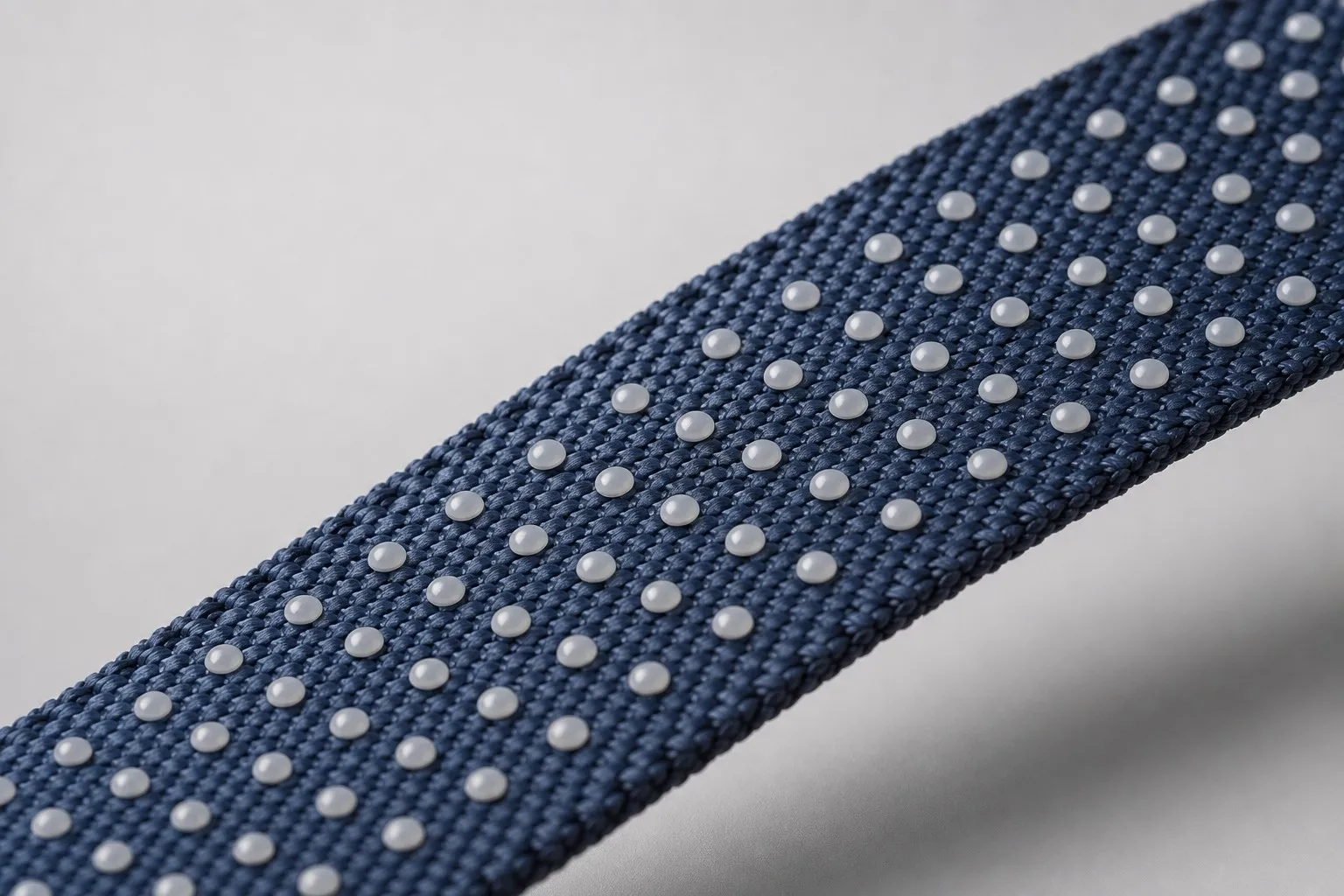
2. Application Scenarios
Anti-slip webbing is used far beyond pet collars and leashes: sports guards, belts and backpack straps need grip for stability; industrial lashing straps rely on high friction to prevent cargo movement; medical rehabilitation aids demand skin-friendly surfaces. Because requirements for friction, wash resistance, softness and strength vary by use case, selection should always consider the end-use conditions.
3. Selection Advice
- Durability and repeated washing (pet products, sportswear) → prefer woven-in or one-piece latex yarn solutions
- Maximum initial grip on a budget → evaluate drip-coating, while checking coating adhesion and weathering tests
- Heavy-duty lashing and outdoor use → choose high-strength bases (nylon/polyester) with physical texture structures
4. YUNGLUNG Webbing: 32 Years of Functional Webbing Expertise
Established in 1995, YUNGLUNG Webbing (Huizhou) Co., Ltd. has 32 years of experience, over 500 looms and a daily output of over one million yards. We offer latex-yarn, drip-coated and jacquard anti-slip webbing with full OEM/ODM support. Our products are certified to GRS, OEKO-TEX Standard 100 and ISO 9001. Contact us for a tailored solution.
Next Page
Next Page
27
2026-08
Green Transformation: GRS Recycled Materials Become the New Standard for Export
27
2026-08
Gradient and Multi-Color Webbing on the Rise: Customization Leads the Trend
27
2026-08
The Pet Economy Is Heating Up — A New Growth Point for Webbing
27
2026-08
Anti-Slip Webbing Explained: Latex Yarn, Drip-Coating and Woven-in Structures
19
2026-08
Subscribe and get news


Contact Information
Yonglong Weaving (Huizhou) Co., Ltd.
Address: Changbu Village, Xinwei Town, Huiyang District, Huizhou City, Guangdong Province
Telephone:13829905177Chen Sheng Phone:13631502993Miss Liu
Fax: 0752-3521132
E-mail:info1@yunglung.com
Enterprise website:www.yunglung.com
Focus on us

WeChat Public Number
Copyright©2024 Yonglong Weaving (Huizhou) Co., Ltd.